BIOGRAPHY / BIOGRAFIE


Giuseppe Lusetti nasce il 17 marzo 1937 a Mergozzo, nell’attuale provincia di Verbania, da un’umile famiglia ossolana. La madre è Francesca Maffioli di Mergozzo, di cui Giuseppe è il terzo di quattro figli. Il padre è Feliciano Lusetti, originario di Croveo nella Valle Antigorio, casaro di professione e instancabile lavoratore.
Giuseppe ha lavorato e scolpito granito e marmi per tutta la vita, iniziando all’età di 11 anni, nelle cave di Montorfano a Mergozzo. A 16 anni inizia a frequentare una scuola serale di disegno; i suoi primi dipinti sono i paesaggi di Mergozzo e dintorni. A 20 anni è già uno degli scalpellini più bravi e richiesti di tutta la zona.
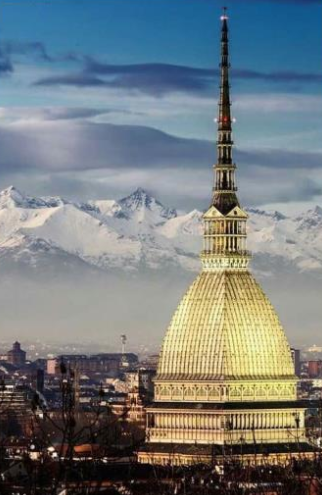
Nel 1959 è stato scelto per scolpire l’ultimo anello del colonnato della Mole Antonelliana, di cui Lusetti scolpisce le basi, le colonne, i capitelli e gli architravi, caduti a causa di un fulmine nel 1953 e ripristinati, in occasione del centenario dell’Unità d’Italia, di cui Torino fu prima capitale.

L’artista realizza poi lavori importanti per committenti sia pubblici che privati. Collabora con artisti come Carlo Manini, eccellente scultore e amico di Lusetti, Andrea Cascella, celebre scultore milanese, Angelo Del Devero, noto pittore e scultore locale, Eva Sorensen, scultrice danese e cittadina onoraria di Mergozzo.
Tra i tanti lavori eseguiti la memorabile “Caravella” in pietra ossolana lunga 7,5 metri, realizzata per il padiglione svizzero delle Colombiadi a Genova in occasione dell’Expo del 1992.
In quegli anni l’artista esegue di suo gusto e fantasia centinaia di opere commissionate: bassorilievi, statue non solamente di carattere religioso, fontane, monumenti commemorativi, figure umane intere, mezzi busti, volti, particolari corporei, figure animali e altro.

Nel 1994 l’artista trova ispirazione per realizzare una piccola catena in granito verde di Mergozzo. La catena misura 1 metro di lunghezza e verrà premiata, nel 1995, da una giuria composta da sei architetti, in occasione della fiera campionaria Millapis di Milano.
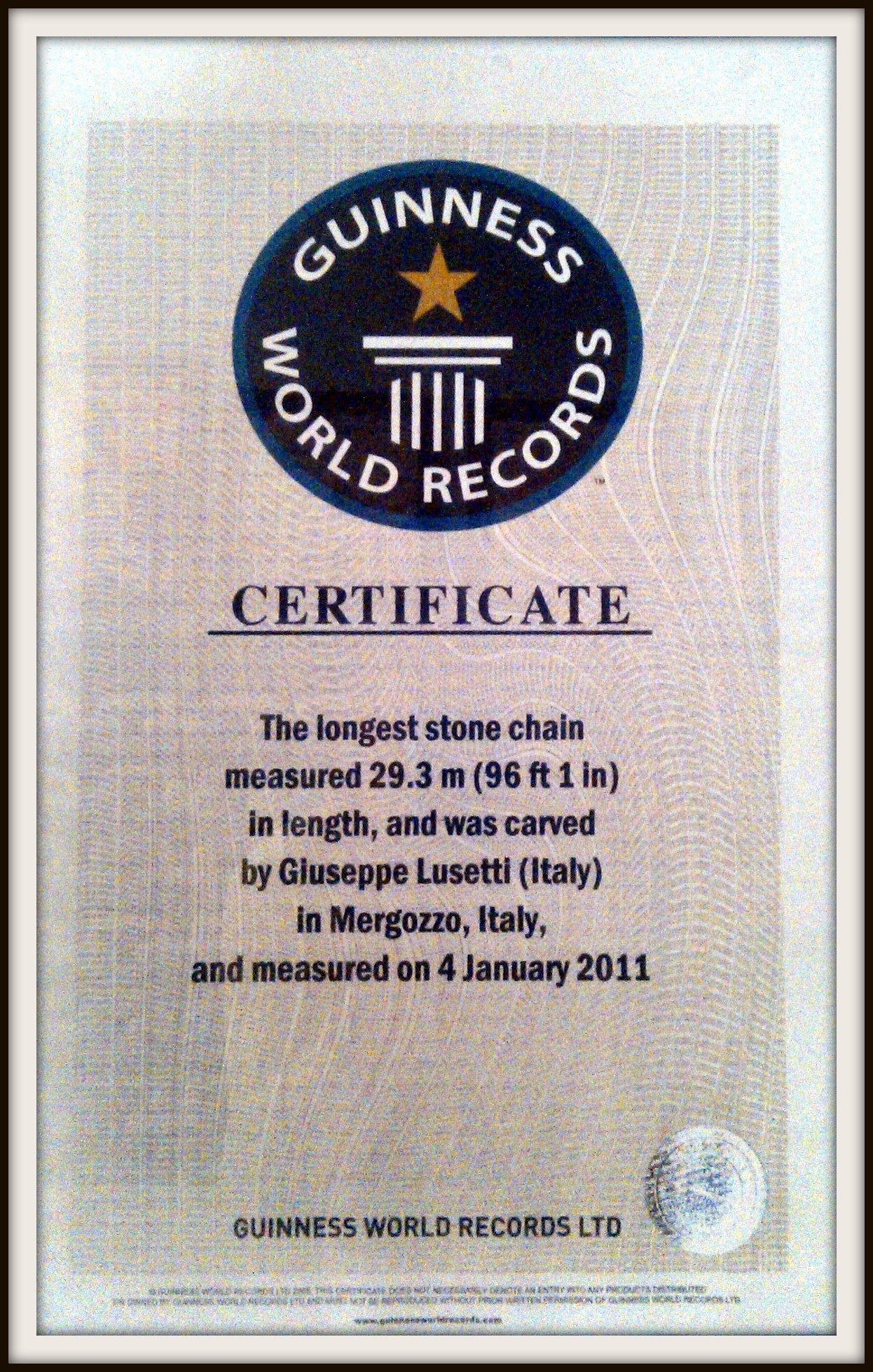
Lo stesso anno l’artista decide di fare una catena più grande e ne realizza una di 15,5 metri, per un totale di 107 anelli. Infine, nel 1996, l’artista prende un blocco di 3,50 metri e realizza in 10 mesi il suo capolavoro: una catena di 29,3 metri ricavata da un unico blocco di granito verde di Montorfano. La catena è composta da 239 anelli, scolpiti uno ad uno e concatenati, senza alcuna giuntura. Premiata dal Guinness World Record come “la catena di sasso più lunga al mondo”, l’unicità e genialità dell’opera è che, oltre ad essere di lunghezza imponente, essendo formata da anelli concatenati ma movibili tra loro, risulta snodabile e quindi la catena stessa ha possibilità di prendere forme diverse, cosa impossibile a qualsiasi altra scultura realizzata in pietra.
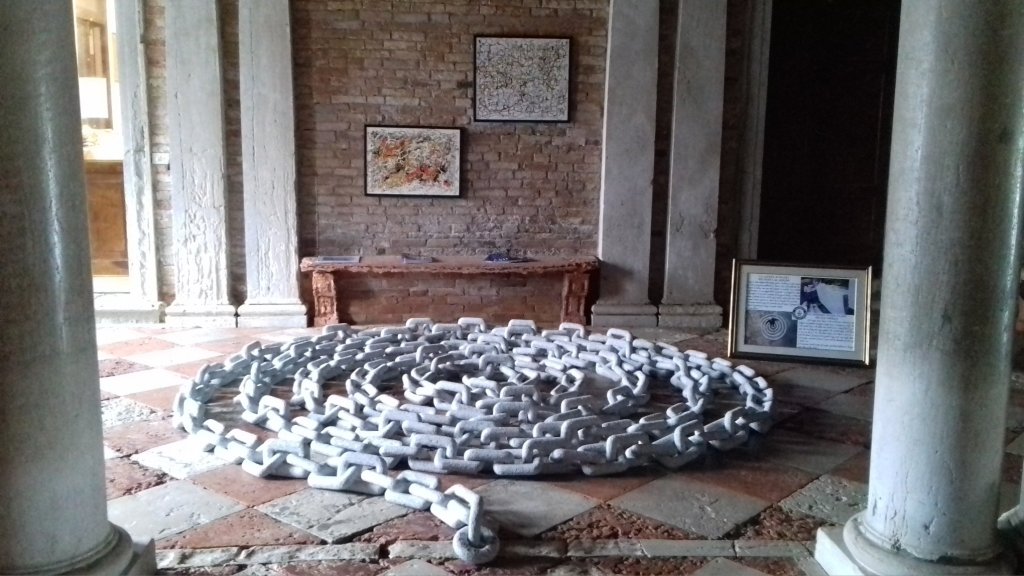
La catena è stata esposta inizialmente solo a livello locale poi, nel maggio 2018, dopo aver suscitato l’interesse del noto critico d’arte Giorgio Grasso, è stata esposta a palazzo Zenobio a Venezia, in occasione della Biennale, dove sono state esposte anche alcune opere pittoriche di Lusetti.
Nel dicembre 2018 la Catena è stata esposta a Street e Visioni Metropolitane a Piacenza Expo, insieme ad altre opere pittoriche dell’artista.
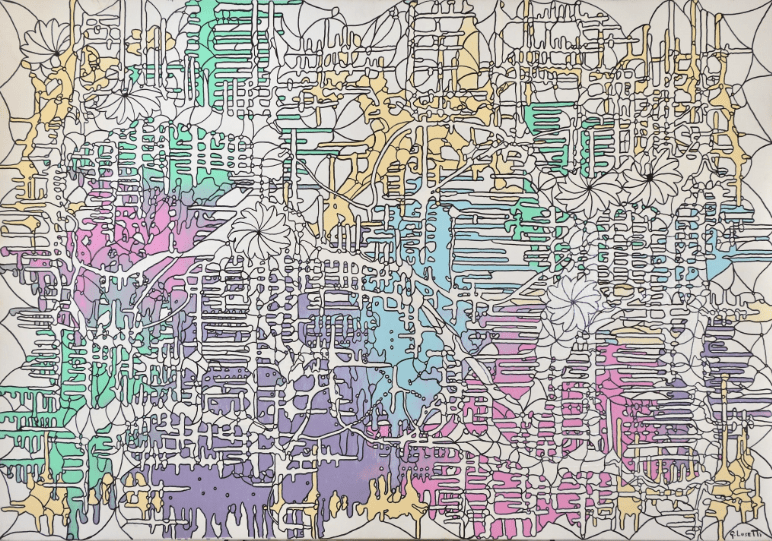
Dal 2000 Lusetti ha ritrovato fonte di ispirazione nell’arte pittorica lasciando il figurativo per esprimersi attraverso “un’arte astratta e libera”, come a lui piace definirla, giocando con forme e colori che si evolvono continuamente ancora oggi.

Giuseppe Lusetti was born on March 17, 1937 in Mergozzo, province of Verbania, Italy. His family was very humble: his mother, Francesca Maffioli, was born in Mergozzo, and she became mum of 4 children, of which Giuseppe was the third. His father was Feliciano Lusetti, born in Croveo, a small village in the Alps, in the Antigorio Valley; he was a professional cheese maker and tireless worker.
Giuseppe worked and sculpted granite and other types of stone throughout his life, starting at the age of 11, in the Montorfano quarries of Mergozzo. When he was 16 years old, he started going to drawing classes at a night school; his first paintings are the landscapes of Mergozzo and the surrounding area. When he was 20 years old, he already was one of the best and most requested stonemasons of the region.
In 1959 Giuseppe Lusetti was chosen to sculpt the upper part of the Mole Antonelliana, (monument and symbol of Turin) which had crashed to the ground due to lightning in 1953. Lusetti sculpted the columns, the bases of the columns, the capitals and the architraves.
The artist also created important works for both private and public clients. He often collaborated with important artists such as Carlo Manini, excellent sculptor and friend of Lusetti, Andrea Cascella, a famous sculptor from Milan, Angelo Del Devero, well-known local painter and sculptor, Eva Sorensen, a Danish sculptor and honorary citizen of Mergozzo.
Among his many artworks, Lusetti also carved the memorable “Caravel”, with the Serizzo stone from the Ossola valley; it’s 7.5 meters long, realized for the Swiss Colombiadi Pavilion in Genoa, on the occasion of EXPO 1992.
In those years the artist realized hundreds of commissioned works, following his own imagination: bas-reliefs, statues, fountains, commemorative monuments, human figures, busts, faces, body details, animals and much more.
In 1994 the artist started to carve his first, short chain out of green granite, it was 1 meter long. This curious work was brought to Milan in 1995, on the occasion of the “Millapis Milan fair” and a jury of six architects, who were really impressed, gave it a prize.
The same year, the artist decided to create a longer chain. He made a chain 15.5 meters long, composed of 107 links. Finally, in 1996, after about 10 months of work, the artist took a block of 3.50 meters in size and realized his masterpiece: a 29.3 meters long chain, carved from a single block of green Montorfano granite. The chain is composed of 239 links, carved one by one and linked together. In 2011 it was recognized as “the longest stone chain in the world” by Guinnes World Records. The uniqueness and ingeniousness of this artwork is, apart from its imposing length, that the chain is composed of movable and articulated rings, which allow the creation to take on different shapes, which is impossible for any other stone sculpture.
The chain was exposed in local exhibitions; in may 2018, after exciting admiration of the well-known art critic Giorgio Grasso, it was exhibited inside of Palazzo Zenobio in Venice, on the occasion of the Biennale; some of Lusetti’s paintings were exhibited in this very same occasion. In December 2018 the chain and 2 paintings were exhibited at the exhibition at Piacenza Expo “Street and Metropolitan Visions”.
Since 2000, Lusetti has rediscovered the passion and the inspiration for painting. In these last years he abandoned the figurative art, to express his feelings through “an abstract and free art” (as he likes to define it) playing with shapes and colors that continuously evolve.

Giuseppe Lusetti wurde am 17. März 1937 in Mergozzo (Provinz Verbania am lago Maggiore) Italien, geboren. Seine war eine sehr bescheidene Familie: seine Mutter, Francesca Maffioli, wurde in Mergozzo geboren, und sie wurde Mutter von 4 Kindern, von denen Giuseppe das dritte war. Sein Vater war Feliciano Lusetti, geboren in Croveo, ein kleines Dorf in den Alpen im Antigorio-Tal; er war ein professioneller Käsemacher und unermüdlicher Arbeiter.
Giuseppe hat sein ganzes Leben lang Granit und andere Steinsorten verarbeitet, und fing schon
im Alter von 11 Jahren an, in den Montorfano-Steinbrüchen von Mergozzo zu arbeiten. Als er 16 Jahre alt war, besuchte er einen Zeichenkurs; seine ersten Bilder stellen die Landschaften von Mergozzo und Umgebung dar.
Als er 20 Jahre alt war, war er bereits einer der besten und gefragtesten Steinmetze der Region. 1959 wurde Giuseppe Lusetti ausgewählt, um den oberen Teil der Mole Antonelliana (Denkmal und Symbol von Turin), welcher 1953 durch einen Blitz zu Boden gefallen war, neuzubauen. Lusetti meisselte die Säulen, die Sockel, die Kapitelle und die Architraven.
Der Künstler schuf auch wichtige Werke für private und öffentliche Kunden. Er arbeitete oft mit bedeutenden Künstlern zusammen, wie Carlo Manini, ein hervorragender Bildhauer und Freund von Lusetti, Andrea Cascella, ein berühmter Bildhauer aus Mailand, der örtliche Künstler Angelo Del Devero und Eva Sorensen, eine dänische Bildhauerin und Ehrenbürgerin von Mergozzo.
Unter seinen vielen Kunstwerken hat Lusetti auch die denkwürdige “Karavelle” aus Serizzo Glimmerstein gemeisselt; sie ist 7,5 Meter lang und wurde für den Schweizer Pavillon realisiert, als in Genua die EXPO 1992 stattfand. In diesen Jahren realisierte der Künstler Hunderte von Auftragsarbeiten nach seiner eigenen Phantasie: Basreliefs, Statuen, Brunnen, Denkmäler, menschliche Figuren, Büste, Gesichter, Körperdetails, Tiere und vieles mehr.
1994 begann der Künstler, seine erste kurze Kette aus grünem Granit zu schaffen, sie war 1 Meter lang. Dieses merkwürdige Kunstwerk wurde 1995 an die „Millapis Mailänder Messe“ gebracht und eine Jury von 6 Architekten, die sehr beeindruckt waren, verlieh ihr den ersten Preis.
Im selben Jahr beschloss der Künstler, eine längere Kette zu bauen. Er schuf eine Kette, die 15,5 Meter lang war, bestehend aus 107 Gliedern. Schließlich nahm der Künstler 1996 einen Block von 3,50 Metern Größe und realisierte, in etwa 10 Monaten Arbeit, sein Meisterwerk: eine Steinkette von 29,3 Metern, gemeisselt in einen einzigen Block aus grünem Montorfano-Granit. Die Kette besteht aus 239 Gliedern, einzeln gemeisselt und miteinander verbunden. Im Jahr 2011 wurde Sie von Guinnes World Records als “die längste Steinkette in der Welt” anerkannt. Die Einzigartigkeit und Genialität von diesem Kunstwerk ist, abgesehen von seiner imposanten Länge, dass es aus beweglichen Gliedern besteht; so ist es der Schöpfung möglich, verschiedene Formen anzunehmen, etwas, das für jede andere Steinskulptur unmöglich ist.
Die Kette wurde erst in ötlichen Ausstellungen gezeigt; dann, im Mai 2018, nachdem sie das Interesse des bekannten Kunstkritikers Giorgio Grasso erweckte, wurde Sie im Palazzo Zenobio in Venedig, anlässlich der Biennale, ausgestellt. Einige von Lusettis Gemälden wurden in der selben Gelegenheit dort ausgestellt. Im Dezember 2018 wurden die Kette und 2 Gemälde in der Ausstellung von Piacenza Expo “Street and Metropolitan Visions” präsentiert.
Seit 2000 hat Lusetti die Leidenschaft und Inspiration für die Malerei wiederentdeckt. In diesen letzten Jahren verließ er die figurative Kunst, um seine Gefühle durch “eine abstrakte und freie Kunst” (wie er sie gerne definiert) auszudrücken. Er liebt es, mit Formen und Farben, die sich dauernd weiterentwickeln, zu spielen.
 Giuseppe Lusetti